

In Blackjack, no card creates more opportunity or confusion than the Ace. While face cards are valuable for their fixed value of 10, the Ace stands apart because it can count as either 1 or 11, depending on what benefits the hand most. This flexibility makes the Ace the single most strategic card in the game.
Understanding how the Ace works is not just about memorizing rules, it’s about knowing when to press an advantage and when to play defensively.
This guide breaks down the Ace from three key angles: overall Blackjack strategy, soft hands, and splitting Aces, to help you improve your Blackjack decisions and avoid costly mistakes.
Blackjack Strategy – Why Does the Ace Change Everything?
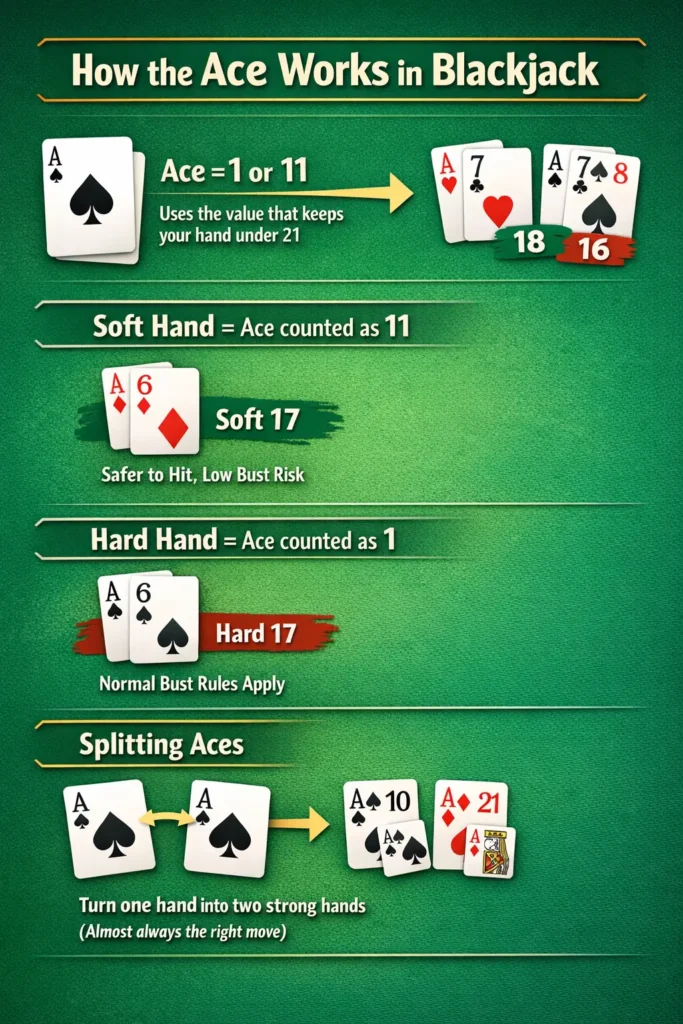
Understanding the Ace’s Value (1 or 11) in Simple Terms
In Blackjack, the Ace can count as 11 or 1. You do not need to choose the value yourself, the game automatically uses whichever value keeps your hand from busting.
For example:
⦁ Ace + 7 = 18 (Ace counts as 11)
⦁ Ace + 7 + 8 = 16 (Ace drops to 1)
The Ace is never “locked” as 11. If counting it as 11 would push your hand over 21, it instantly becomes 1. This is what gives the Ace its safety.
Why Hands With an Ace Are Safer?
When your hand includes an Ace, you can usually take more hits without busting. This is very important, because busting is the most common way new players lose.
Compare these two hands:
⦁ 10 + 6 = 16 → very risky to hit
⦁ Ace + 5 = 16 → much safer to hit
Even though both totals are 16, the second hand is safer because the Ace can protect you.
Why You Should Not Panic When the Dealer Has an Ace?
Seeing the dealer show an Ace makes many beginners nervous. Some players immediately take insurance (small extra bet) or change their strategy out of fear.
Important tip:
⦁ Insurance bets are usually a bad idea
⦁ A dealer Ace does not mean automatic Blackjack
⦁ You should still play your hand correctly
Soft Hands Explained – Playing Ace + Any Card
What a Soft Hand Really Means?
A soft hand is any hand where the Ace is currently being counted as 11. It’s called “soft” because it can take an extra card without immediately risking a bust. As long as the Ace remains at 11, the hand has built-in safety.
For example, an Ace and a 6 form a soft 17. This hand can be improved safely, which makes it very different from a hard 17.
Why Soft Hands Should Not Be Played Passively?
One of the biggest beginner mistakes is treating soft hands like finished hands. Seeing a total of 17 or 18 often makes players want to stand. With soft hands, this approach wastes the Ace’s main advantage.
Soft hands are meant to be played actively. Because the risk of busting is low, hitting or doubling often gives you a better chance to reach a stronger total.
Understanding Soft Hand Transitions
If you hit a soft hand and the Ace must drop to 1 to avoid busting, the hand becomes hard. At that moment, the safety net is gone, and you should switch to normal hard-hand strategy.
Understanding when this transition happens prevents confusion and helps players stay consistent in their decisions.
Splitting Aces – A Rule Every Player Should Remember
Why Two Aces Are Better Split Than Kept Together?
Two Aces equal 12, which is not a strong hand on its own. Splitting them creates two new hands, each starting with an Ace. This gives you two chances to build powerful totals like 19, 20, or Blackjack-strength hands. Splitting turns a weak situation into a strong one.
What Happens After You Split Aces?
Most casinos apply limits after an Ace split. You’re usually allowed only one card per Ace, and re-splitting may not be allowed. Some tables also reduce the payout for a Blackjack formed after a split. Even with these restrictions, splitting Aces remains the correct move almost every time.
Splitting Aces Against Different Dealer Cards
From a beginner’s perspective, this rule is simple: split Aces against almost any dealer upcard. The math strongly supports this decision, and it removes hesitation at the table.
Let the Ace Work for You, Not Against You!
The Ace is the most forgiving card in Blackjack. It gives you flexibility, reduces bust risk, and opens up strong opportunities through soft hands and splits. When you learn to trust the Ace instead of fearing it, your decisions become calmer and more consistent. Over time, this understanding builds confidence and leads to better play at the table.
FAQs
Yes, in most situations the Ace is the best card you can receive. It gives your hand flexibility, reduces the risk of busting, and creates opportunities for stronger totals, especially when doubling or splitting.
A soft hand includes an Ace counted as 11, which means you can take an extra card without immediately risking a bust. If the next card is high, the Ace simply changes to 1. Hard hands don’t have this protection.
Not always. Some tables restrict doubling on certain soft hands. This depends on house rules, not on strategy. Always check the table rules before playing.
Yes. Even when casinos limit you to one card after splitting Aces, each Ace still gives you a strong starting position. The restrictions reduce the advantage slightly, but splitting Aces is still the correct move.
No. The rules for how Aces are valued are the same in online and live Blackjack. Differences only come from table rules, not from how the Ace itself works.
Some casinos don’t treat a 21 made after splitting Aces as a “natural” Blackjack. This is a house rule designed to reduce payouts, not because the hand is weaker.