


Advantage gambling is often misunderstood because it sits at the intersection of casino mathematics, game design, and player behavior. Many players assume it refers to betting systems or “smart play,” while others believe it only applies to professional gamblers. In reality, advantage gambling is neither a trick nor a guarantee. It is a narrow concept that describes specific situations where the normal cost of gambling is reduced.
Understanding advantage gambling requires looking beyond individual wins and focusing on how games, bonuses, and rules behave over time. In this blog, we provide a detailed overview of advantage gambling, its various types, and how it is used by players in online casinos.
What Advantage Gambling Means?
It refers to playing under conditions where the expected loss is lower than usual, or in rare cases, temporarily neutralized. Casinos design games so that, over thousands of rounds, the house earns a predictable margin. Advantage gambling occurs only when something meaningfully alters that balance.
What actually creates an advantage?
Not luck, momentum, or intuition. An advantage comes from structure, such as:
⦁ A bonus that offsets expected losses
⦁ Cashback or rebates applied to real wagering results
⦁ Game rules that return more to the player than standard versions
In other words, advantage gambling is not about winning more often, but about losing less over time.
What advantage gambling is not?
To clarify common confusion:
⦁ Increasing or decreasing bet size does not change odds
⦁ Betting systems do not alter game mathematics
⦁ Provably fair or transparent systems ensure fairness, not profitability
⦁ Short winning streaks are not evidence of an edge
These distinctions matter because many players unknowingly label normal variance as “advantage.”
Types of Advantage Gambling
Advantage gambling does not exist equally across all games or situations.
1. Promotion-Based Advantage
Promotion-based advantage is the most common and accessible form of advantage gambling. It occurs when bonuses or rewards partially offset the normal cost of playing, reducing the player’s expected losses over time. Common examples include:
⦁ Deposit bonuses with low wagering requirements, where only a small amount of play is needed before withdrawals are allowed
⦁ Loss-based cashback, calculated on real net losses over a session, day, or week
⦁ Reload offers, which are made available periodically rather than on every deposit
When used carefully, they can:
⦁ Lower the average loss per session
⦁ Smooth out short-term volatility
⦁ Improve long-term results without changing gameplay
Playing every bonus without understanding the terms often eliminates any benefit.
2. Game Rule & RTP Differences
Another form of advantage gambling comes from choosing better versions of the same game. Not all games with the same name or theme offer identical returns, and small rule differences can have a measurable impact over time. Such as:
⦁ Blackjack variants paying 3:2 on a natural blackjack versus 6:5, which significantly increases the house edge
⦁ Baccarat tables with side rules or commissions that reduce overall return
⦁ Slot games offered with different RTP settings, depending on the provider or configuration
Individually, these differences may seem minor. Over hundreds or thousands of rounds, they become meaningful. Two players can play the same game with the same strategy and experience very different results depending on which version they choose.
The goal is not to find a “perfect” game, but to avoid structurally worse ones.
3. Loyalty & Volume-Based Structures
Loyalty and volume-based advantages are designed for long-term engagement. Casinos use these systems to reward consistency, while players use them to reduce the overall cost of playing. Typical examples include:
⦁ Cashback percentages linked to monthly or weekly activity
⦁ Loss rebates during promotional periods
⦁ Tier-based benefits that provide ongoing rewards
While these benefits do not change game outcomes, they influence net results across many sessions. This form of advantage:
⦁ Requires tracking and consistency
⦁ Rewards volume, not aggression
⦁ Works best with defined limits
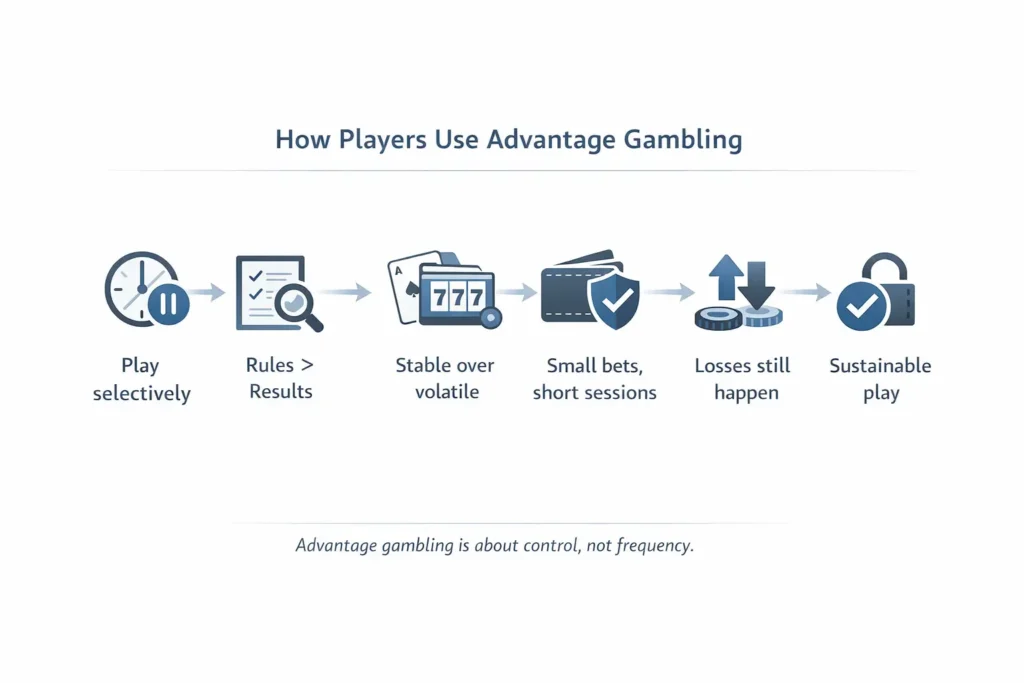
How Players Use Advantage Gambling?
Choosing When to Play, Not Playing Continuously
The first and most important step in advantage gambling is deciding when to play at all. Experienced players evaluate promotions, game rules, and reward structures before making a deposit. If the conditions do not meaningfully improve the cost of play, they simply do not engage.
This selectivity is critical. Advantage gambling fails when players feel compelled to play continuously or chase every offer.
Focusing on Conditions Instead of Short-Term Results
Rather than judging success by wins or losses, advantage-focused players assess:
⦁ How much value a bonus or cashback realistically provides
⦁ Whether wagering requirements align with their normal play
⦁ If the games available maintain higher return profiles
They understand that short-term results are unreliable, while structural conditions are not. A losing session under favorable conditions is still preferable to a winning session achieved under poor ones.
Selecting Games with Known and Stable Behavior
Game choice is also deliberate. Advantage-oriented players tend to stick with games they understand well, particularly those with stable behavior and known return profiles. They avoid unnecessary switching between formats or chasing volatility, as frequent changes increase exposure without improving odds.
Choosing higher-return versions of familiar games does not guarantee winning sessions, but it helps avoid structural disadvantages that accumulate over time.
Managing Risk Through Bankroll and Session Control
Even when conditions are favorable, risk remains. They control:
⦁ Session length
⦁ Bet size relative to bankroll
⦁ Frequency of deposits and withdrawals
They avoid aggressive bet increases and resist the urge to recover losses quickly.
Understanding Variance and Maintaining Emotional Discipline
One of the most overlooked aspects of advantage gambling is psychological discipline. Players accept that:
⦁ Favorable conditions do not guarantee short-term wins
⦁ Losing streaks can occur even under good setups
⦁ Emotional reactions often erase any mathematical benefit
As a result, experienced players are more likely to stop early, withdraw after modest gains, and disengage when conditions deteriorate.
Operating Within Platform Rules and Limitations
Sustainable advantage gambling operates within published terms. Players who push too aggressively, by abusing promotions or exploiting technical gaps, often face restrictions. Experienced players avoid this by:
⦁ Playing transparently
⦁ Following bonus conditions
⦁ Maintaining predictable, consistent behavior
This approach allows them to continue benefiting from favorable conditions over time.
Wrapping Up:
Advantage gambling is not about beating the casino. It is about avoiding unnecessary losses by playing only when conditions make sense. Players who understand this tend to play less, not more and that restraint is often the real advantage.
FAQs
Both, but behavior matters more. The mathematical edge is often small. How a player manages sessions, emotions, and exposure determines whether that edge has any practical impact.
Yes. Promotions, rules, and reward structures change. What works under one set of conditions may no longer be effective later. Advantage gambling depends on the environment, not the player, which is why experienced players continuously reassess instead of assuming a setup will remain favorable.
No. Frequent switching often increases volatility and undermines any structural benefit. Advantage gambling works best when players stay within familiar game formats and controlled environments rather than chasing novelty.
Rules usually stay fixed during a session, but promotions and reward structures can change over time.
Yes. Frequent or optimized withdrawals can influence how platforms structure future promotions.